
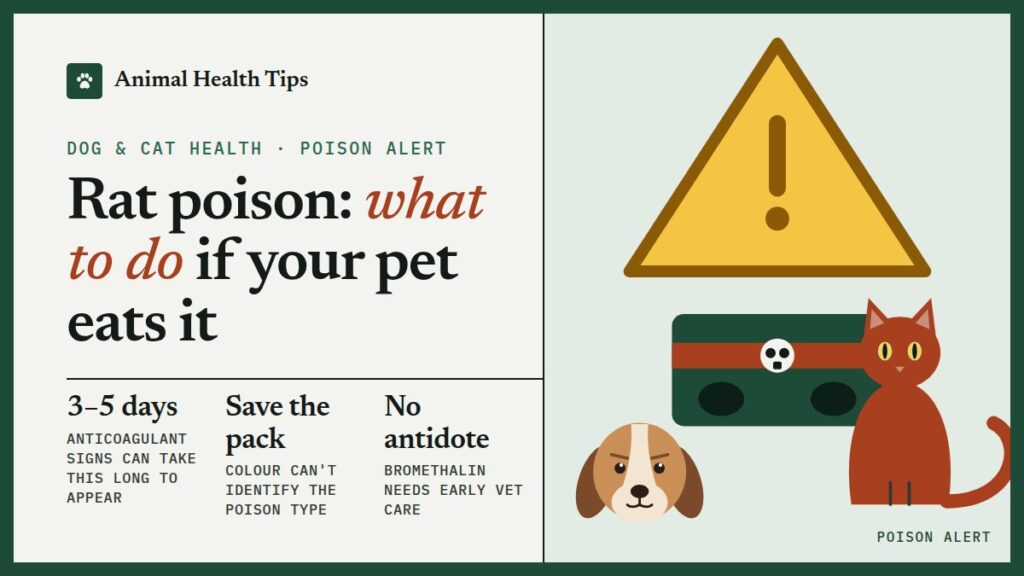
Rat poison is designed to be found and eaten. Pellets, blocks, granules and liquids are laid where rodents go: sheds, garages, kitchens, cellars, exactly where curious dogs and cats wander. The Merck Veterinary Manual says pets usually gain access by eating baits directly or by eating poisoned rodents, and that early veterinary intervention gives the best chance of successful treatment.
In this guide8 sections
Go to a vet now if your pet may have eaten rat poison
- Do not wait for symptoms. PDSA warns that signs may not show for around three to five days after eating anticoagulant rat poison.
- Take the bait packaging with you. Rat poison comes as pellets, blocks, granules and liquids in colours including teal, blue, green and pink, and PDSA says the colour cannot identify the type, so the vet needs the packaging.
- Note roughly when your pet ate it and how much bait is missing.
- UK: Animal PoisonLine, 01202 509000 — open 24 hours, run by the Veterinary Poisons Information Service; a fee applies.
- US: ASPCA Animal Poison Control, (888) 426-4435 — open 24 hours; a consultation fee applies.
How do pets get poisoned by rat poison?
Two routes. First, direct: a dog finds loose bait blocks in a shed or garage, or a cat samples pellets in a cellar. Second, a pet eats a recently poisoned rodent. The Merck Veterinary Manual says pets can be poisoned both ways, and PDSA adds that if a dog has eaten a recently poisoned rat or mouse, contact your vet.
Cats are exposed the same way. Cats Protection warns that bait can harm a cat that eats a poisoned rodent even when the bait itself is kept out of the cat’s reach. And PDSA is blunt: there is unlikely to be a rat poison that will not harm your dog if they eat it. There is no dog-safe rat poison.
The four types of rat poison and how they harm pets
The four groups work in completely different ways, and the type decides what the vet does.
Anticoagulant rodenticides are the most frequent cause of rodenticide poisoning in pets, says Merck. They stop the blood clotting: the AVMA explains they block the liver’s production of clotting factors II, VII, IX and X, and some are highly toxic from a single feeding.
Bromethalin is one of the most common rodenticide types, sold as blocks, soft baits, pellets and meal, says VCA. Dogs are usually poisoned by finding loose blocks or reaching the bulk container. There is no antidote, so early decontamination by a vet is extremely important and can be lifesaving, says VCA.
Cholecalciferol, or vitamin D3, rodenticides are a significant health threat to dogs and cats, says Merck: they push blood calcium far too high, hardening soft tissue throughout the body.
Zinc phosphide is a farm and outside-use bait. In stomach acid it forms phosphine gas, and signs begin rapidly, says Merck: vomiting and abdominal pain, aimless running and howling, then depression, difficulty breathing and convulsions, with death due to respiratory arrest.
Rat poison timelines: when the danger shows
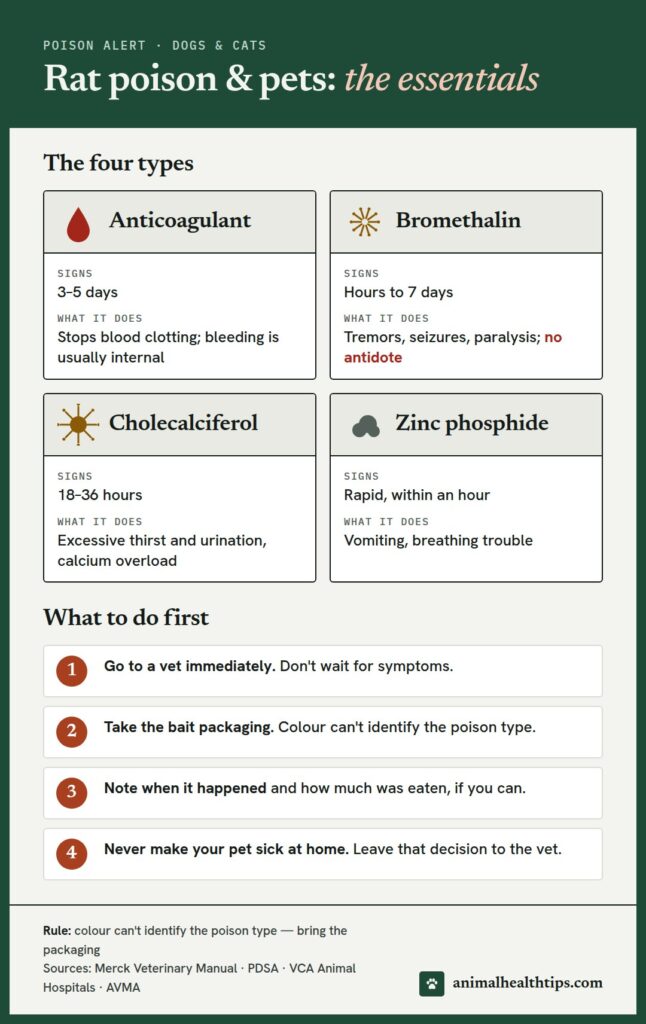
With rat poison, the clock is everything: Merck stresses that early veterinary intervention gives the best chance of successful treatment, and some types stay silent for days:
| Poison type | When signs start | What happens |
|---|---|---|
| Anticoagulant | 3–5 days | Bleeding is usually internal; it may show at wounds or surgery sites (AVMA). |
| Bromethalin | Hours to days | Convulsant within 24 hours; paralytic from 1–7 days, progressing over 1–2 weeks (VCA). |
| Cholecalciferol | 18–36 hours | Thirst and heavy urination, then appetite loss; later vomiting blood, bloody diarrhoea, kidney damage (Merck). |
| Zinc phosphide | Rapid | Can make a dog very unwell within an hour (PDSA). Vomiting, abdominal pain, aimless running, breathing trouble, convulsions (Merck). |
The anticoagulant delay is the trap. A pet can look perfectly fine for days while its clotting factors drain away. PDSA’s advice is clear: do not wait for signs before calling the vet.
What are the signs of rat poisoning in pets?
Because the poisons differ so much, so do the signs. Merck lists the patterns:
- Bleeding (anticoagulant). Anaemia, semisolid masses of blood in the tissues, and bleeding into the gut, eye, nose, lungs or urine. Weakness, lack of coordination, colic and rapid breathing can follow; depression and loss of appetite can appear even before bleeding (Merck).
- Brain and nerve signs (bromethalin). VCA describes two syndromes: convulsant within 24 hours (severe tremors, seizures, high body temperature, agitation, running fits, worse with light and noise) and paralytic from 1–7 days (lethargy and poor appetite, then rear-limb weakness, wobbliness and paralysis).
- Calcium overload (cholecalciferol). Within 18–36 hours: depression, loss of appetite, passing large amounts of urine and excessive thirst; later vomiting blood, bloody diarrhoea and progressive kidney damage (Merck).
- Gut and breathing (zinc phosphide). Rapid vomiting, abdominal pain, aimless running and howling, then depression, difficulty breathing and convulsions (Merck).
Secondary poisoning from a poisoned rodent is possible with bromethalin, says VCA, though it has not been demonstrated experimentally in dogs. Rule of thumb: if your pet eats a rodent that may have been poisoned, contact your vet.
What to do if your dog or cat eats rat poison
Act at once, even if your pet looks fine:
- Call your vet immediately, or go straight to the clinic. Early treatment gives the best chance of success (Merck).
- Take the bait packaging with you. The vet needs the type: anticoagulant, bromethalin, cholecalciferol or zinc phosphide. Colour and shape cannot identify it (PDSA).
- Say when it happened and roughly how much is missing. If you ring the UK’s Animal PoisonLine first, have ready the time of ingestion, the product brand and packaging, the quantity, and your pet’s age, weight, medical history and when any signs started.
- Do not make your pet sick at home. Only your vet should decide what decontamination is needed.
How vets treat rat poisoning
Treatment depends on the type. For anticoagulant poisoning, Merck says vitamin K1 is the antidote concept, given over two to four weeks with weekly clotting checks. Severe bleeding may need blood transfusions. For bromethalin there is no antidote, so early decontamination by the vet is the treatment and can be lifesaving, says VCA; milder cases may recover over weeks, but severe signs carry a poor to grave prognosis. After cholecalciferol poisoning, blood calcium is monitored for up to two weeks after treatment stops, alongside a low-calcium diet, says Merck.
How to prevent it
- Keep all rodenticides out of pets’ reach, and never assume a product is pet-safe. PDSA says there is unlikely to be a rat poison that will not harm your dog.
- Store bait and packaging locked away, and note where every bait point is.
- Supervise pets in sheds, garages and outbuildings where bait may be laid, and tell your pest controller you have pets.
- If your pet eats a dead or dying rodent, treat it as a possible secondary poisoning and contact your vet.
For another poison with a hidden delay, read our guide to antifreeze poisoning in cats.
Key takeaways
- Pets are poisoned by eating bait directly or by eating poisoned rodents.
- Anticoagulant signs can take 3–5 days to appear. Never wait for symptoms.
- Take the bait packaging to the vet: colour and shape cannot identify the type.
- Go to a vet immediately; early treatment gives the best chance of success.
- There is no dog-safe rat poison.
Frequently asked questions
My dog ate a dead rat. Could it be poisoned?
Possibly. PDSA says if a dog eats a rat or mouse that was recently poisoned, there is a risk the dog is affected and you should contact your vet. Never assume a dead rodent is safe.
How long does it take for rat poison to affect a dog?
It depends on the type. Anticoagulant signs usually appear 3–5 days after ingestion (PDSA, AVMA); bromethalin can act within hours or take up to seven days (VCA); cholecalciferol signs generally develop within 18–36 hours (Merck); zinc phosphide acts fast, and PDSA says a dog could become very unwell within an hour.
Is there an antidote for rat poison in dogs?
For anticoagulant poisoning, Merck describes vitamin K1 as the antidote concept, given over two to four weeks. For bromethalin there is no antidote at all, so early decontamination by a vet can be lifesaving (VCA).
Can a cat be poisoned by eating a poisoned mouse?
Yes. Cats Protection warns that bait can harm a cat that eats a poisoned rodent even when the bait itself is out of the cat’s reach. Seek veterinary advice immediately if yours may have eaten one.
Is there a pet-safe rat poison?
No. PDSA says there is unlikely to be a rat poison that will not harm your dog if they eat it. No product should be treated as pet-safe; keep pets away from all bait and store it locked away.
What should I tell the vet or poison line?
The time of ingestion, the product brand and its packaging, roughly how much was eaten, your pet’s age, weight and medical history, and when any signs started. Animal PoisonLine advises having all of this ready before you call.
Sources
- Merck Veterinary Manual — Rodenticide poisoning
- PDSA — Rat poisoning in dogs
- VCA Animal Hospitals — Bromethalin rodenticide poisonings in dogs
- AVMA — Rodenticide comparison (PDF)
- Animal PoisonLine — We are here 24/7
- Cats Protection — Keeping your cat safe (2025, PDF)
This guide is general information, not a diagnosis. If you are worried about your pet, contact your vet.
1 comment