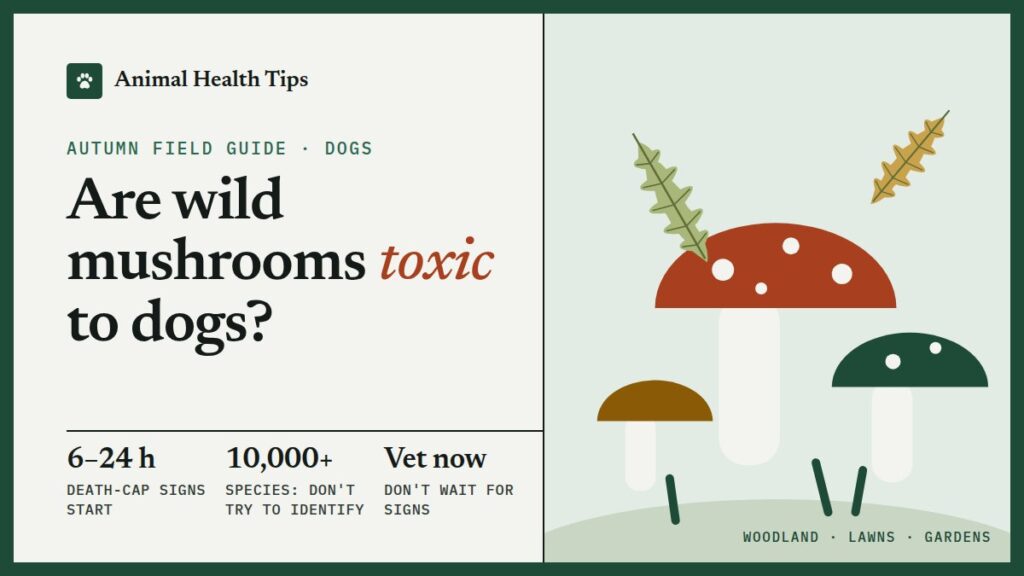
October is peak mushroom season. They appear overnight on lawns, in parks and along woodland paths, exactly where dogs go sniffing. The Merck Veterinary Manual warns that dogs are particularly susceptible to mushroom poisoning because of their indiscriminate eating habits and tendency to roam. The reassuring part: the ASPCA says the majority of wild mushrooms are non-toxic. The frightening part: the toxic ones can cause severe illness, organ damage and even death.
In this guide8 sections
- Why are wild mushrooms so dangerous to dogs?
- Which wild mushrooms are the most dangerous?
- Mushroom poisoning: the timelines that matter
- What are the symptoms of mushroom poisoning in dogs?
- What to do if your dog eats a wild mushroom
- How vets treat mushroom poisoning
- How to prevent it on autumn walks
- Frequently asked questions
Go to a vet now if your dog eats a wild mushroom
- Do not wait for symptoms. PDSA advises calling your vet straight away if your pet eats something potentially dangerous.
- Do not waste time trying to identify the mushroom. UC Davis says time is of the essence and getting your dog to a vet as soon as possible is the priority.
- Note roughly when your dog ate it and what has happened since.
- UK: Animal PoisonLine, 01202 509000 — open 24 hours, run by the Veterinary Poisons Information Service; a fee applies.
- US: ASPCA Animal Poison Control, (888) 426-4435 — open 24 hours; a consultation fee applies.
Why are wild mushrooms so dangerous to dogs?
It comes down to a guessing game no owner can win. The AKC notes that only 50 to 100 of the world’s roughly 50,000 mushroom species are known to be toxic, but the poisonous ones can really hurt a dog or even kill them. Merck adds that visual identification is difficult even for experienced mycologists, and chewing distorts a mushroom’s appearance further. That is why PDSA’s advice is blunt: avoid them completely.
The toxic species work in different ways, and knowing which clock you are on is what saves dogs. Some irritate the gut within minutes. Others quietly damage the liver while the dog looks perfectly fine.
Which wild mushrooms are the most dangerous?
The one name every dog owner should know is the death cap, Amanita phalloides. Merck calls it the mushroom species most frequently implicated in human and animal mushroom fatalities worldwide, and UC Davis warns it is extremely toxic and can be fatal to dogs even in small amounts, causing liver failure within 24 hours.
UC Davis also names Amanita gemmata (jeweled deathcap), Amanita muscaria (deadly agaric), Galerina marginata (deadly Galerina), Gyromitra species (false morel), Inocybe species and Clitocybe dealbata as toxic to dogs. But don’t try to memorise them: VCA says that unless you are a mushroom expert, it’s best to assume any mushroom you find could be a poisonous one.
Mushroom poisoning: the timelines that matter
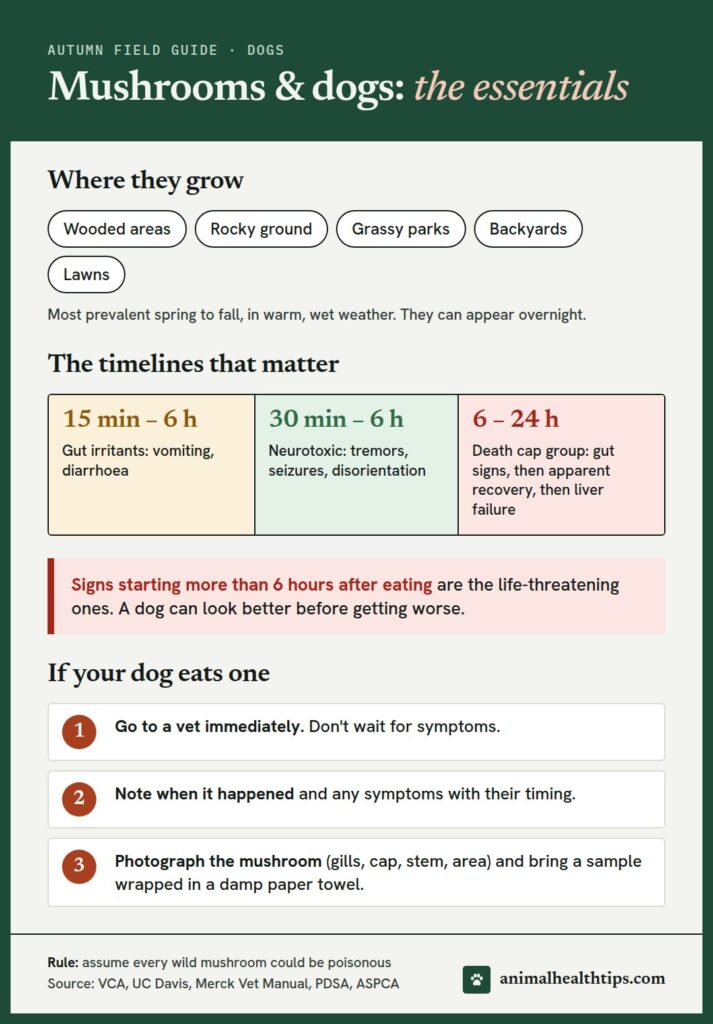
The time between eating and the first signs largely decides the prognosis, says Merck: species that cause signs within 3 hours are generally self-limiting and not life-threatening, while those causing signs more than 6 hours after ingestion are life-threatening. VCA groups the toxins like this:
| Toxin group | When signs start | What happens |
|---|---|---|
| Gut irritants | 15 minutes to 6 hours | Vomiting and diarrhoea; some also slow the heart rate and cause breathing problems. Weakness and dehydration can follow. |
| Neurotoxic | 30 minutes to 6 hours | Weakness, wobbliness, tremors, disorientation, drooling, vomiting and seizures. Body temperature may rise. |
| Liver-damaging (death cap group) | 6 to 24 hours | Gut signs first, then the dog may seem to recover, while liver failure quietly progresses: jaundice, weakness, lethargy, sometimes coma. |
| Kidney-damaging | 12 hours to a week or more | Nausea, vomiting, going off food, drinking and weeing more, then dehydration. Rare in pets in North America. |
The liver-damaging pattern is the trap. VCA describes owners watching their pet nibble a mushroom, seeing nothing happen, then gut signs at 6 to 24 hours, then an apparent recovery, all while liver failure progresses. If it is not treated quickly and aggressively, VCA says liver failure is irreversible.
What are the symptoms of mushroom poisoning in dogs?
UC Davis lists vomiting and diarrhoea, increased or decreased urination, liver failure, kidney injury, excessive drooling, tremors and seizures. PDSA’s general poisoning signs add low energy, twitching, struggling to breathe and collapse. Put together, call your vet urgently if you see:
- Vomiting, diarrhoea or heavy drooling
- Low energy, weakness or wobbliness
- Twitching, tremors or seizures (fits)
- Struggling to breathe or collapse
- Yellowing of the gums or eyes (jaundice), a late sign of liver damage
- Drinking or weeing much more, or much less, than usual
What to do if your dog eats a wild mushroom
- Call your vet immediately, or go straight to the clinic. UC Davis says time is of the essence: don’t spend time trying to identify the species, since there are over 10,000 known mushroom species. The ASPCA warns that a delay in treatment can be dangerous with some mushrooms.
- Tell them when it may have happened and describe any symptoms and when they started. Timing helps the vet judge which toxin group they are dealing with.
- Bring evidence. VCA advises taking a photo of the mushroom showing the gills, cap, stem and the surrounding area, and bringing a specimen wrapped in a damp paper towel.
- Never try to make your dog sick at home. Only your vet can decide whether vomiting should be induced, and VCA describes it as something the veterinarian does, soon after ingestion, alongside other decontamination steps.
How vets treat mushroom poisoning
Merck is frank: there are no proven antidotes, so treatment is decontamination and intensive supportive care. Depending on timing, VCA says your vet may induce vomiting, give activated charcoal to bind the toxin, pump the stomach, and use a fluid drip to fight dehydration and support the kidneys and liver. The sooner treatment starts, the better the odds.
How to prevent it on autumn walks
Mushrooms grow best in warm, wet weather, says VCA, and the ASPCA adds they are most prevalent from spring to fall, often appearing overnight. They turn up in wooded areas, rocky ground, grassy parks, backyards and lawns, so:
- Patrol your garden regularly and remove every mushroom before your dog goes out. The ASPCA suggests walking the yard each day, since mushrooms can appear overnight.
- Keep a close eye on your dog on walks and hikes in parks, woods and rocky areas, which UC Davis flags as prime growing spots.
- Assume all wild mushrooms are harmful until proven otherwise. It is the only safe rule when identification is this unreliable.
- Teach a solid “leave it”. It won’t solve everything, but it buys you the seconds that matter on a walk.
Mushrooms are only one of autumn’s hazards. Read our autumn field guide to conkers and acorns, and if your dog hoovers up seasonal treats of the human kind, our guide to what to do when dogs eat Halloween sweets.
Key takeaways
- Most wild mushrooms are non-toxic, but the death cap can kill a dog even in small amounts.
- Signs within 3 hours are usually gut irritation; signs after 6 hours can mean liver or kidney damage.
- A dog can look better before getting worse. Never wait for symptoms.
- Go to a vet immediately, note the timing, and bring a photo or a sample wrapped in a damp paper towel.
- Patrol your garden daily in mushroom season and supervise woodland walks.
Frequently asked questions
Are shop-bought mushrooms safe for dogs?
Yes, generally. The ASPCA says mushrooms sold in grocery stores for human consumption are generally considered safe for pets and are not expected to cause problems. The AKC agrees that washed supermarket mushrooms are fine for dogs. It’s wild mushrooms that are the gamble.
How quickly do mushroom poisoning symptoms appear in dogs?
It depends on the toxin. Gut-irritant types act within 15 minutes to 6 hours, neurotoxic types within 30 minutes to 6 hours, liver-damaging types like the death cap within 6 to 24 hours, and kidney-damaging types from 12 hours to a week or more.
My dog ate a mushroom but looks fine. Is it okay?
Not necessarily. The liver-damaging mushrooms cause gut signs 6 to 24 hours later, and the dog can then appear to recover while liver failure progresses. Go to a vet immediately rather than waiting to see.
Can I identify a toxic mushroom myself?
No, not reliably. The Merck Veterinary Manual says identification is difficult even for experienced mycologists, and chewing distorts the appearance. The ASPCA says identification is best left to trained professionals. Assume any wild mushroom could be poisonous.
Should I make my dog vomit after eating a mushroom?
No, not at home. Only your vet can decide whether vomiting should be induced. Call your vet or go to the clinic immediately instead.
Are mushrooms more dangerous in autumn?
They are most prevalent from spring to fall in warm, wet weather, and PDSA flags autumn fungi in damp areas as a seasonal hazard. In warmer climates or mild winters they can grow year-round.
Sources
- UC Davis School of Veterinary Medicine — Mushroom toxicity in dogs
- VCA Animal Hospitals — Mushroom toxicity
- Merck Veterinary Manual — Overview of mushrooms toxic to animals
- PDSA — Poisonous plants
- ASPCA — Fungus among us: mushroom toxicosis
- AKC — Fruits and vegetables dogs can and can’t eat
This guide is general information, not a diagnosis. If you are worried about your pet, contact your vet.