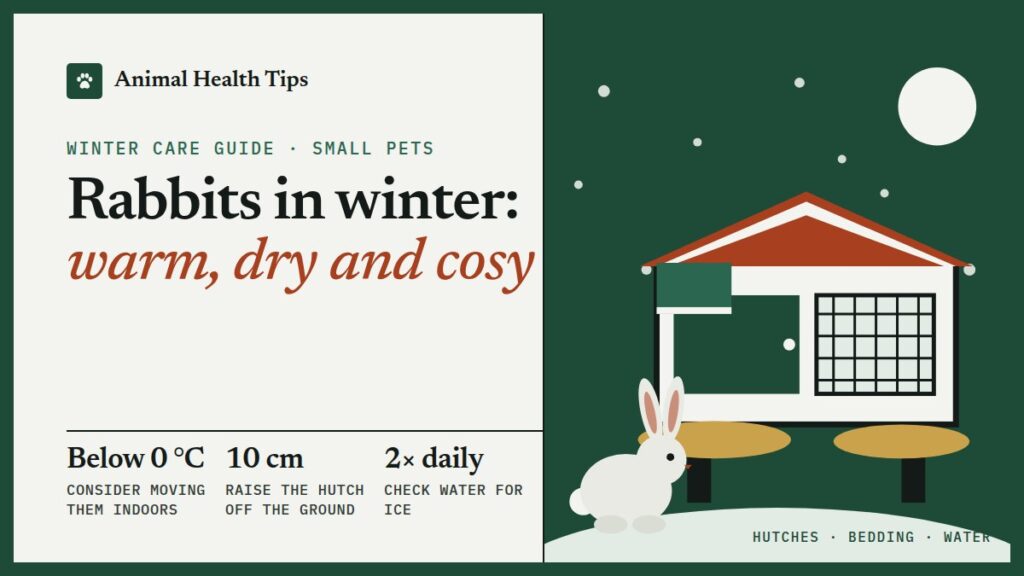
The first hard frost is on the car windscreen, and your rabbits are still outside. It is natural to worry. The good news is that healthy outdoor rabbits cope with cold months well: they trade their summer coat for a thick winter one and often get livelier as the temperature drops. What they cannot cope with is wind, damp and frozen water. Winter rabbit care is less about keeping them hot and more about keeping them dry, sheltered and well fed.
In this guide9 sections
Call your vet today if your rabbit
- is not eating or drinking normally,
- is not passing normal droppings,
- or its behaviour is off — hunched, quiet or unusually still.
- The RSPCA’s winter advice is clear: seek veterinary advice urgently if any of these change.
How cold is too cold for outdoor rabbits?
The RSPCA puts the ideal ambient temperature for domestic rabbits at 10 to 20 °C — but that is an ideal, not a limit. Healthy rabbits grow a thicker winter coat and, the charity says, cope with the cold months fairly well, often becoming more active and playful, binkying about in the cold.
The line the RSPCA draws is freezing: if temperatures start to drop below freezing, consider moving the rabbits’ home indoors, or into a shed, outhouse or unused garage protected from the weather.
One caveat: domestic rabbits do not have the thick fur of wild rabbits and are more sensitive to low temperatures, the RSPCA warns — and draughty, damp, poorly ventilated or dirty environments can cause suffering and illness. Cold is fine. Cold plus wet and wind is not.
Winter-proofing the hutch
The hutch is your rabbits’ winter coat. Set it up before the first frost:
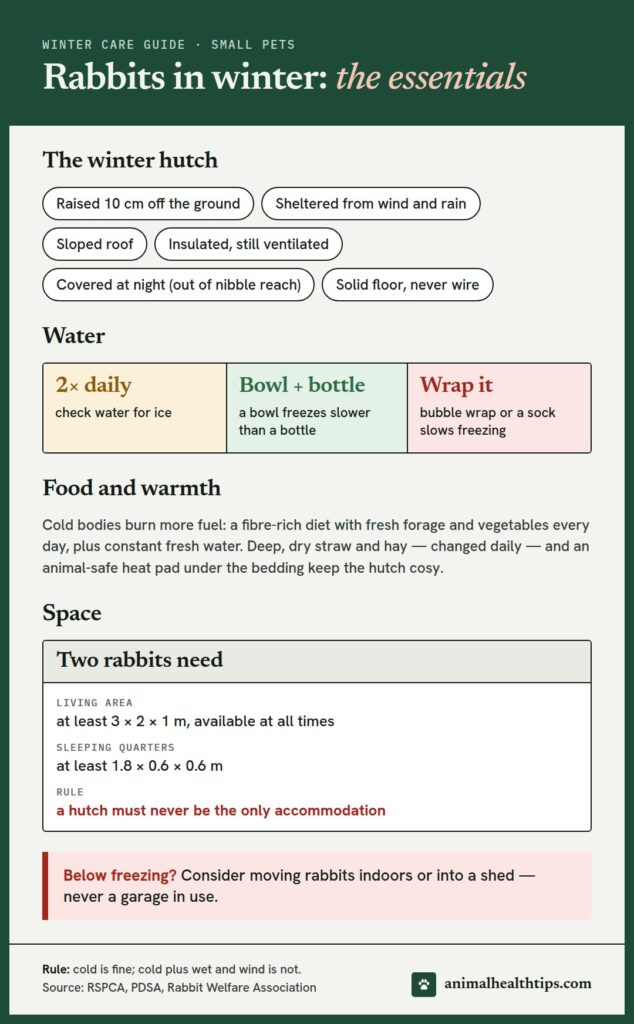
- Raise it at least 10 cm (4 inches) off the ground. This stops the base getting damp and rotten and prevents frost seeping up from the ground (RSPCA).
- Site it sheltered, facing away from the prevailing wind and rain. A sloped roof is preferable so water drains away (RSPCA).
- Insulate, but keep it ventilated. Line the walls with cardboard, blankets or insulation boards — while keeping the hutch well-ventilated (RSPCA).
- Cover up at night. An old blanket or tarpaulin over the hutch adds warmth; keep the cover out of nibble reach and make sure air still flows (PDSA). Covering most of the hutch while leaving a small area exposed keeps the balance right.
- Predator-proof it. Foxes and badgers get hungrier and bolder in winter, so the hutch must be sturdy (RSPCA).
- Use a solid floor, never wire. Wire floors cause sore feet and hocks, and outdoor shelters should sit above the ground to stop damp and deter predators (RSPCA).
Bedding: deep, dry and changed daily
Bedding is where the warmth lives. The RSPCA recommends dust-free straw and hay, plus shredded paper for comfort, over absorbent layers such as newspaper or dust-free, non-cedar wood shavings. Give plenty of bedding hay or straw for the rabbits to snuggle into, and change it regularly to keep the hutch fresh and dry (PDSA).
The daily job that matters most: remove wet bedding every day. Wet bedding freezes on cold nights and could make rabbits ill (RSPCA). Clean toilet areas daily and give the full enclosure a proper clean around once a week, making sure the housing is dry before the rabbits go back in.
For extra warmth, an animal-safe heat pad under the bedding helps (PDSA). And give hiding places with two entry and exit points, so one rabbit cannot block the other in — rabbits huddle together to share body heat (RSPCA).
Water: beating the freeze
Dehydration is a real winter risk because bottles and bowls ice over. Check drinking water at least twice a day to make sure it has not frozen. A bowl is less likely to freeze than a bottle, so the RSPCA advises providing both.
Slow the freeze: wrap water bottles in bubble wrap or an old sock, and place an animal-safe heat pad under the water bowl (PDSA). Even so, no trick replaces the twice-daily check.
Feeding rabbits in winter
Cold bodies burn more fuel. Rabbits need more calories in winter to maintain body temperature, so feed a fibre-rich diet with fresh forage and vegetables every day, plus constant fresh, clean water (RSPCA).
If you want a quick way to check treats and garden foods, our human-food safety checker covers what is and is not safe for pets.
| Winter job | How often |
|---|---|
| Remove wet bedding | Daily (RSPCA) |
| Check water for ice | At least twice daily (RSPCA, PDSA) |
| Clean toilet areas | Daily (RSPCA) |
| Full enclosure clean | About once a week (RSPCA) |
| Fresh forage and vegetables | Every day (RSPCA) |
How much space do outdoor rabbits need?
Winter is not a reason to shrink their world. The Rabbit Welfare Association says a pair of average-sized rabbits needs a single enclosed area of at least 3 m × 2 m × 1 m high, available at all times — and sleeping quarters of at least 1.8 m × 0.6 m × 0.6 m (6 ft × 2 ft × 2 ft). A hutch must never be the sole or main accommodation.
The RSPCA’s minimum matches: living space for two medium-sized rabbits no smaller than 3 m × 2 m × 1 m, including the main shelter and exercise area, with room to stand on hind legs without ears touching the roof, lie fully outstretched and turn around.
Keep the exercise area permanently attached and accessible at all times, even in cold weather: rabbits still need natural light and exercise, with a covered, dry area in the run and plenty of hiding places to shelter in (PDSA, RWAF). If you can, move the hutch and run closer to the house or into a garden shed for extra protection (RWAF).
When to bring rabbits indoors for winter
In the worst weather, bring them inside. A porch or conservatory suits, the PDSA advises, because it avoids the shock of a centrally heated home. A car-free shed or garage is another option.
Two rules. Move them gradually — a sudden shift from a chilly hutch to a warm room is hard on rabbits, so use a shed or porch as a halfway step over a few days. And never house or exercise rabbits in a garage that is in use, because vehicle exhaust fumes are harmful and can be fatal (RSPCA, PDSA).
Keep rabbits in pairs or groups regardless: company is essential, and in winter two rabbits snuggling together stay warmer than one alone (PDSA).
Winter dangers to watch for
Winter brings its own hazards beyond the cold:
- Hungrier predators. Foxes and badgers get bolder in winter, so sturdy, predator-proof housing is essential (RSPCA).
- Poisons. The RSPCA lists antifreeze — which causes kidney failure and death — rodent poisons, foxglove, ivy, rhubarb, avocado and chocolate as winter poisons. Our guide to rat and mouse poison explains what to do if a pet reaches bait.
- Flystrike, all year. It is more common in warm weather, but the RSPCA notes it can happen at any time of year: keep rabbits clean and check fur, skin, rear end and tail regularly.
Key takeaways
- Healthy rabbits cope with cold well; wind, damp and frozen water are the real enemies.
- Raise the hutch 10 cm, shelter it from wind and rain, insulate with ventilation, and cover it at night.
- Remove wet bedding daily and check water at least twice a day — bowls freeze slower than bottles.
- Feed more in winter: fibre-rich food, fresh forage and vegetables daily.
- Below freezing, consider moving rabbits indoors or into a shed — never a garage in use.
Frequently asked questions
How cold is too cold for outdoor rabbits?
The RSPCA’s ideal is 10–20 °C, but healthy rabbits with a thick winter coat cope with cold months well. The practical line: when temperatures drop below freezing, consider moving them indoors or into a shed, outhouse or unused garage.
Can rabbits live outside all winter?
Yes, if their housing is dry, draught-free, well insulated and spacious, with dry bedding, unfrozen water and extra food. Bring them in during the worst weather — especially young, thin or older rabbits.
Should I cover the hutch at night?
Yes. An old blanket or tarpaulin adds warmth, but keep the hutch ventilated and the cover out of nibble reach (PDSA). Cover most of the hutch while leaving a small area exposed for air.
Why does my rabbit’s water keep freezing?
It will in frost. Check at least twice a day, provide a bowl as well as a bottle (bowls freeze slower), wrap bottles in bubble wrap or an old sock, and put an animal-safe heat pad under the bowl (PDSA).
Do rabbits need more food in winter?
Yes. Rabbits burn more calories to stay warm, so the RSPCA advises a fibre-rich diet with fresh forage and vegetables every day, plus constant fresh water. They should always have plenty of hay available too.
Can rabbits get flystrike in winter?
Yes — the RSPCA notes flystrike can happen all year round, though it is more common in warm weather. Keep rabbits clean and check their fur, skin, rear end and tail regularly.
Sources
- RSPCA — Rabbits in winter
- PDSA — Keeping rabbits warm in winter (blog)
- RSPCA — Rabbits: environment
- Rabbit Welfare Association & Fund — Space recommendations
This guide is general information, not a diagnosis. If you are worried about your pet, contact your vet.