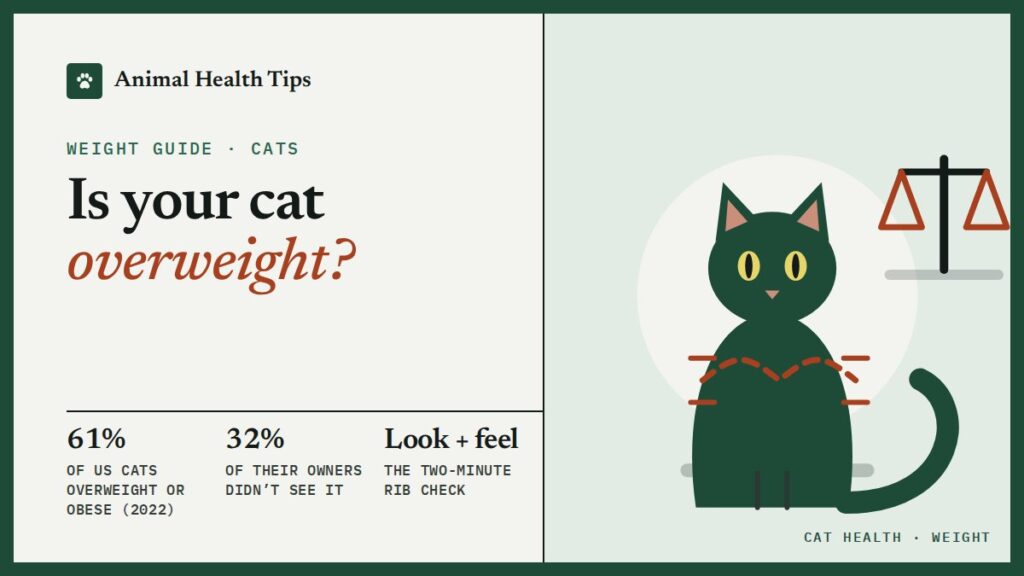
October is World Pet Obesity Month, and the numbers are striking: in the Association for Pet Obesity Prevention’s 2022 survey, 61% of cats assessed at US clinics scored overweight or obese — yet 32% of their owners described them as “normal”, “ideal” or “thin”. Most owners simply do not see the extra weight.
In this guide7 sections
This October, APOP has launched updated 2026 guidelines to help vets and owners talk about body condition, alongside two surveys — of owners and clinics, running 1 October to 31 December 2026 — tracking how common excess body fat really is. A good moment to check your own cat: the two-minute check below needs no scales and no appointment — and if it raises a question, your vet can confirm the score.
See your vet promptly rather than starting a diet if
- Your cat has gained weight suddenly or rapidly
- Your cat struggles to groom, move or jump as usual
- Your cat is breathing heavily, lethargic or off their food
- You are unsure how overweight your cat is, or how to start
The look test: what to see from above and the side
The body condition score — the BCS — is how vets judge whether a pet is too thin, too heavy or just right, and it starts with looking.
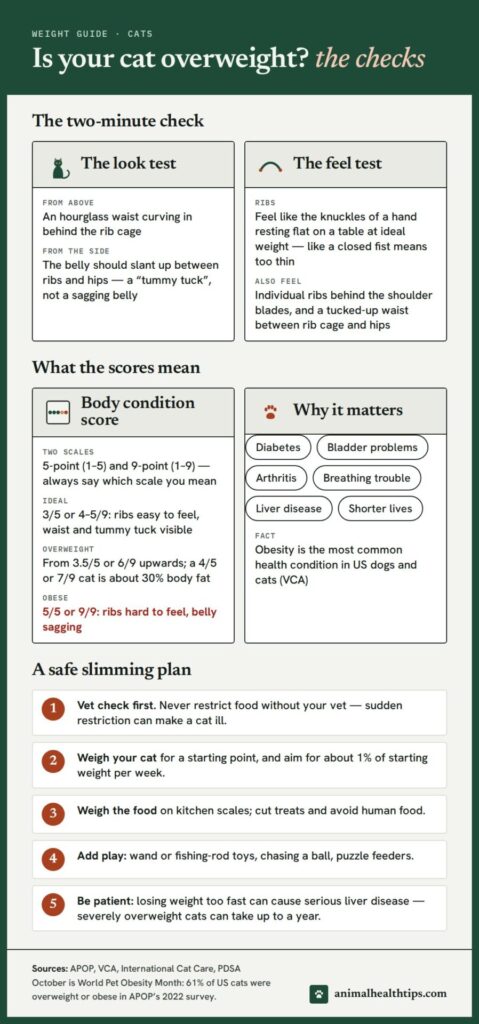
Stand over your cat and look down. At a healthy weight, the body narrows behind the rib cage into a waist, like an hourglass, with a clear indentation on each flank at the end of the rib cage (VCA).
Now look from the side, at your cat’s level: the belly should slant upwards between rib cage and hind legs — the tummy tuck. A sagging belly signals excess weight.
The feel test: the knuckle check
Looking is only half the check — long fur hides a lot. The BCS is assessed by looking and feeling together.
Place your thumbs on the backbone and spread your fingers across the rib cage: at a healthy weight you feel a thin fat layer with the ribs right underneath, like knuckles on a flat hand (VCA). A closed fist means too thin; the palm side means too heavy.
Two more spots (VCA Canada): behind the shoulder blades, feel the individual ribs easily with the flat of your fingers; the waist between rib cage and hips should feel tucked up. The backbone, stroked neck to tail, should be easy to feel without pressing hard.
What the body condition scores mean
Vets score body condition on a 5-point scale (1 to 5) or a 9-point scale (1 to 9) — and it matters which one is meant, because a 3 is ideal on the 5-point scale but thin on the 9-point scale. Always ask which scale your vet is using.
| Score | Meaning | What you notice |
|---|---|---|
| 3/5 or 4–5/9 — ideal | A healthy weight | Ribs easy to feel without pressing; obvious waist and tummy tuck |
| 3.5/5 or 6/9 — just over ideal | Slightly overweight | A slight fat layer over the ribs; waist visible but not prominent; minimal tummy tuck |
| 4/5 or 7/9 — heavy | Overweight | Ribs need finger pressure to feel; waistline not apparent; about 30% body fat |
| 5/5 or 9/9 — obese | Obese | Ribs hard to feel under a thick fat layer; belly projects downward and outward |
International Cat Care considers a cat 10 to 19% heavier than its ideal weight to be overweight — but the score, recorded alongside the weight, is what your vet tracks.
Why extra weight matters
VCA calls obesity the most common health condition in US dogs and cats, and notes that overweight pets have shorter lifespans:
- Diabetes. Overweight cats face a dramatically increased risk of diabetes mellitus (VCA Canada) — PDSA lists it first.
- Joint damage and arthritis. Extra weight stresses the joints — and fat tissue is biologically active: fat cells produce the hormone leptin, which causes inflammation inside the joints (VCA Canada).
- Bladder and urinary problems. Lower urinary tract disease is listed as a risk by PDSA and International Cat Care.
- Breathing and heart strain. Extra fat makes breathing harder (flat-faced breeds such as Persians are hit hardest, PDSA), and VCA links obesity to heart disease.
- Liver disease. Rapid weight loss itself can trigger hepatic lipidosis, a potentially fatal liver disease — which is why crash dieting is dangerous, as the plan below explains.
- Anaesthetic and immune risks. International Cat Care lists increased anaesthetic risk and decreased immune function, alongside skin disease and constipation.
None of this is about blame. As APOP’s survey shows, a third of owners of overweight pets do not see the weight — the recognition gap is the norm, not the exception.
Why cats put on weight
A few factors stack the odds:
- Neutering. Neutering drops a cat’s metabolic rate by about 20% (International Cat Care) — Blue Cross suggests cutting food by about a quarter afterwards.
- Age. Cats between 2 and 10 need less energy and are more likely to be overweight; cats under 2 are less likely.
- Indoor life. Cats that live strictly indoors burn fewer calories (Cornell), and less-active cats are at greater risk.
- Free feeding. Energy-dense, tasty foods left down all day make overeating easy.
- Medication. Some medicines predispose cats to weight gain — another reason the vet should be part of the plan.
Extra weight raises diabetes risk, and drinking more is one early sign. If your cat’s water bowl is emptying faster than usual, our guide to cats drinking more water explains when to see the vet.
A safe slimming plan
If your cat needs to lose weight, the plan starts at the vet — not the food bowl: sudden restriction can make a cat ill, so never cut food without your veterinary team’s say-so. Work through these steps with them:
- Get a vet check first. Your vet will weigh your cat, score body condition, and rule out medical causes — Cornell’s advice is direct: always see your veterinarian before starting.
- Aim for slow and steady. PDSA suggests about 1% of starting weight per week: faster loss can cause hepatic lipidosis, a potentially fatal liver disease, and severely overweight cats can take up to a year (International Cat Care).
- Weigh the food. Weigh portions on kitchen scales — scoops are easy to overfill — cut down on treats, and keep human food off the menu.
- Add play, not just less food. Wand or fishing-rod toys, chasing a ball and puzzle feeders all help. Cornell suggests play sessions and climbing games — and getting visitors to play with toys instead of offering snacks.
- Weigh in regularly. Weight loss works best as a partnership with your vet, with regular weigh-ins and body-condition checks (VCA Canada).
Key takeaways
- October is World Pet Obesity Month: 61% of US cats were overweight or obese in APOP’s 2022 survey, and a third of their owners didn’t see it.
- Check your cat in two minutes: an hourglass waist from above, a tummy tuck from the side, and ribs that feel like knuckles on a flat hand.
- Extra weight raises the risk of diabetes, arthritis, bladder and breathing problems — and overweight pets have shorter lives.
- Never crash-diet a cat: see your vet first, aim for about 1% of body weight a week, and expect months, not weeks.
Frequently asked questions
How can I tell if my cat is overweight without a vet visit?
Do the two-minute check: from above, look for an hourglass waist; from the side, look for an upward tummy tuck rather than a sagging belly; feel the ribs — they should feel like knuckles on a flat hand. If the waist is gone and the ribs are hard to feel, ask your vet to confirm the score.
How fast should my cat lose weight?
About 1% of starting weight per week is PDSA’s suggested target. Faster loss can trigger hepatic lipidosis, a potentially fatal liver disease — so think in months, not weeks, for your cat.
Do I need a special diet food?
Discuss any diet change with your vet first. If your cat is only a little overweight, feeding a bit less and cutting high-calorie treats may be enough — but the vet should set the plan, as cutting too far can leave out nutrients.
My cat begs for food constantly. What can I do?
Replace some food rewards with play: wand toys, chasing a ball, or a puzzle feeder. Cornell suggests getting visitors to play with toys instead of offering snacks — and weigh every portion, as scoops are easy to overfill.
Are indoor cats bound to get fat?
Indoor cats burn fewer calories (Cornell) and less-active cats are at greater risk — but they are not bound to gain weight. Measured portions, daily play and regular weigh-ins keep most indoor cats healthy.
When should I call the vet about my cat’s weight?
Before starting any weight-loss plan, always. And promptly if weight gain is sudden, or if your cat struggles to groom, move or breathe comfortably, or seems lethargic. Your vet will score body condition, rule out medical causes and set a safe target.
Sources
- Association for Pet Obesity Prevention — World Pet Obesity Month 2026: New Communication Guidelines
- VCA Animal Hospitals — Body Condition Score in Cats
- International Cat Care — Obesity in Cats
- PDSA — Your Cat’s Body Shape
- Cornell University College of Veterinary Medicine — Ask Elizabeth: Care of Obese Cats
This guide is general information, not a diagnosis. If you are worried about your pet, contact your vet.