Bringing home a kitten means a first vet visit is on the calendar — and vaccinations are usually the top item on the list. The jabs protect against diseases that are still common and can be fatal in young kittens, including cat flu and feline infectious enteritis. The schedules differ between the UK and the US, but the basics are the same everywhere.
In this guide8 sections
After the jab: call your vet if
- Your kitten’s face swells, or there is vomiting, diarrhoea, breathing difficulty or collapse. Call straight away.
- A lump at the injection site is still there after 3 months, is bigger than 2 cm, or is growing a month on.
- Swelling at the injection site has not gone down within three to four weeks.
What is my kitten vaccinated against?
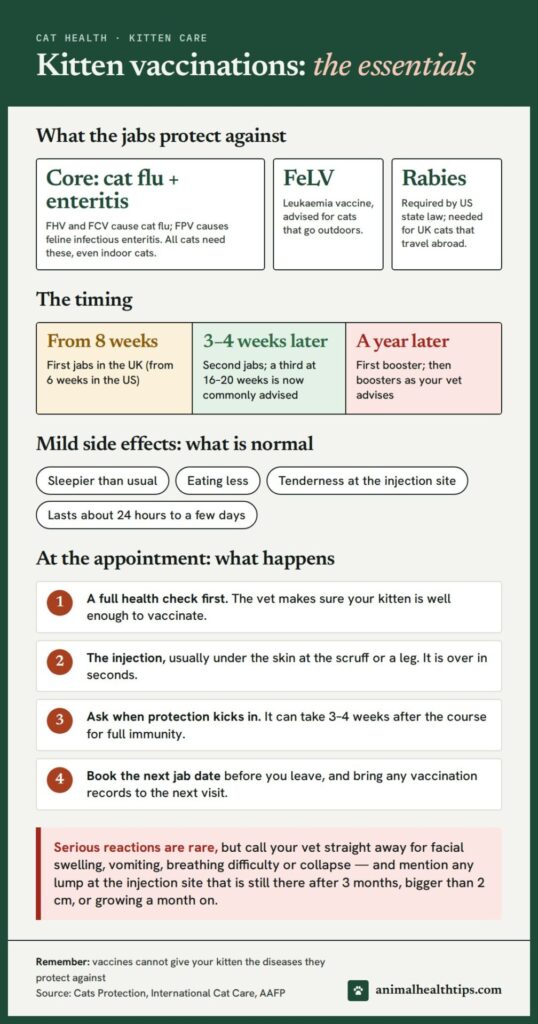
Vets divide cat vaccines into core and non-core. The core group is recommended for every cat in the UK, whether they live indoors or outdoors. It covers three diseases: feline herpesvirus and feline calicivirus, the two main causes of cat flu, and feline parvovirus, which causes feline infectious enteritis.
Cat flu can make vulnerable cats, such as young kittens and elderly cats, seriously ill. Feline infectious enteritis is worse: it causes severe disease especially in kittens and is often fatal. The virus is extremely hardy and survives a long time in the environment.
Then there is feline leukaemia virus, or FeLV. It is a lifelong infection, and Cats Protection notes that most cats die within three years of diagnosis. It spreads through fighting, mutual grooming and sharing food and water bowls and litter trays. In the UK, the FeLV vaccine is advised if your cat goes outside or lives with cats that go outside.
Rabies vaccination works differently. In the US, it is required by state law — in New York state, for example, all cats over six months old must be vaccinated. In the UK, cats need a rabies vaccination if they travel abroad under the Pet Travel Scheme, and it cannot be given before 12 weeks of age.
When do kitten vaccinations start?
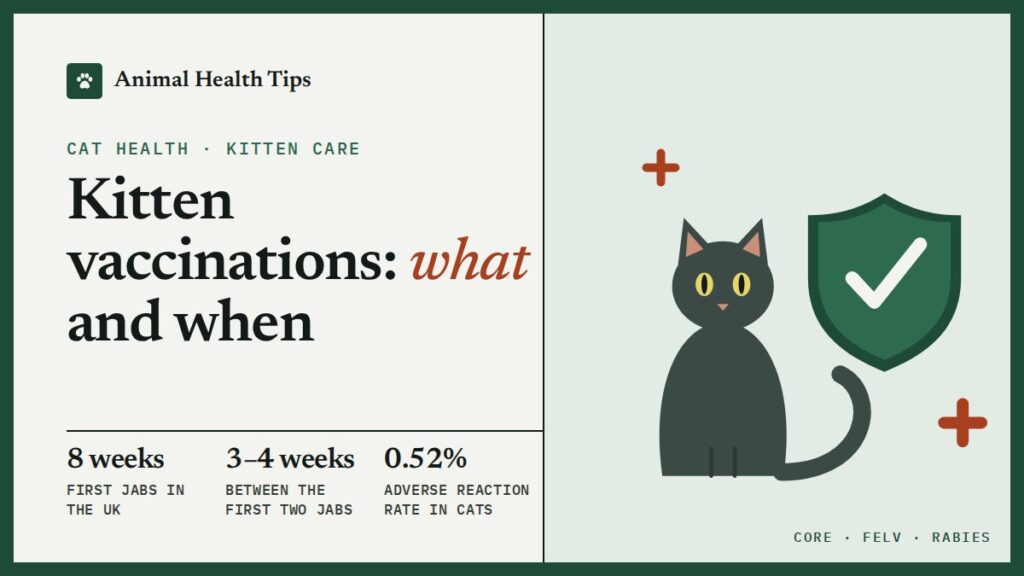
In the UK, kittens are usually vaccinated from around eight weeks old, with a second injection three to four weeks later, and a booster a year after that. International Cat Care notes that a third vaccination, especially against feline infectious enteritis, at 16 to 20 weeks is now commonly recommended to make sure the kitten is protected.
In the US, the schedule starts a little earlier and runs longer: the first dose of the FVRCP vaccine — the ‘3-in-1’ covering the three core diseases — can be given from six weeks, then repeated every three to four weeks until 16 to 20 weeks, with rabies added from 12 weeks. A year after the primary series comes a booster, then FVRCP every three years, though your vet will tailor this to your cat.
Full protection is not instant. Cats Protection explains that after the primary course it can take three or four weeks for the body to build up its immune response, so your vet can tell you when your kitten’s cover is complete.
Why does a kitten need several jabs?
It comes down to maternal antibodies — the immunity a kitten gets from its mother at birth and through nursing. These antibodies protect the kitten, but they also neutralise vaccine antigens, and they wear off at a different rate in every kitten. That is why one early jab cannot be relied on: vets give a series, spaced a few weeks apart, so that at least one dose lands after the maternal protection has faded. This is also why kittens should be kept away from unvaccinated cats until the full course is done.
What happens at the vaccination appointment?
- A full health check first. The vet examines your kitten and talks through the plan — the visit should never be just the needle.
- The injection itself, usually given under the skin. It is over in seconds, and most kittens barely notice.
- A note of what was given and when the next jab is due. Bring any vaccination records you have, so the timing stays right.
- A plan for the next visit. Book the follow-up date before you leave.
How often are boosters needed?
Guidance differs, so think of boosters as a conversation with your vet rather than a fixed rule:
| What the guidance says | |
|---|---|
| UK charities | First booster about a year after the kitten course; many practices then boost yearly |
| AAFP (US) | Revaccinate 1 year after the primary series, then FVRCP every 3 years; FeLV yearly for high-risk cats |
| International Cat Care | First booster at 12 months, then every 1–3 years depending on vaccine, disease and risk |
What matters most is not missing the first annual booster — that is the one that locks in the kitten course.
Are kitten vaccinations safe?
Serious reactions are rare. In the largest survey, covering about 1.25 million vaccine doses given to nearly half a million cats, adverse reactions within 30 days were reported in 0.52% of vaccinated cats. The usual reactions are mild: the kitten may be sleepier than usual, eat less, or be tender where the injection went in. Blue Cross says these are mild and usually last around 24 hours, and any swelling at the injection site should go down within three to four weeks. Vaccines cannot give your kitten the diseases they protect against.
Very rarely, a cat can have an allergic reaction: vomiting, diarrhoea, breathing difficulty, facial swelling or collapse. This happens in roughly 1 to 5 vaccinations in 10,000. There is also the ‘3-2-1’ rule for lumps at the injection site: have any lump checked if it is still there after 3 months, is bigger than 2 cm, or is growing a month after vaccination. Injection-site sarcoma occurs in fewer than 1 in 20,000 vaccines given.
Does an indoor kitten still need vaccinating?
Yes. The core vaccines are recommended for all cats, indoor or outdoor, because the diseases they cover are widespread or severe. Feline parvovirus is the reason most often given: it survives a long time in the environment and can be carried into the home on shoes and clothing, so even a kitten that never goes out is at risk. The FeLV vaccine is the one that depends on lifestyle — mainly for cats that go outside or live with cats that do — and knowing the signs your cat is in pain helps you spot if a tender injection site is more than the usual mild soreness.
Key takeaways
- Kittens are usually vaccinated from around 8 weeks, with a second jab 3–4 weeks later and a booster a year on.
- Core vaccines cover cat flu and feline infectious enteritis; FeLV is advised for outdoor cats; rabies rules depend on where you live.
- Full protection can take 3–4 weeks after the primary course.
- Mild sleepiness is normal; serious reactions are rare, in 0.52% of vaccinated cats.
Frequently asked questions
When should kittens get their first vaccination?
From around eight weeks old in the UK, with a second injection three to four weeks later. In the US, the first dose can be given from six weeks, then repeated every three to four weeks until 16 to 20 weeks. Rabies vaccination cannot start before 12 weeks of age.
How many injections does a kitten need?
Usually two, three to four weeks apart, followed by a booster a year later. A third injection at 16 to 20 weeks, especially against enteritis, is commonly recommended to close the gap left by fading maternal antibodies.
Does my indoor kitten need vaccinating?
Yes. Core vaccines are recommended for all cats, indoor or outdoor. Feline parvovirus survives a long time in the environment and can be carried into your home on shoes and clothing, so indoor kittens are still at risk.
What side effects can kitten vaccinations cause?
Most are mild: your kitten may be sleepier than usual, eat less, or be tender at the injection site. These usually last about 24 hours to a few days. Serious reactions are rare — about 0.52% of vaccinated cats in the largest survey.
How long until my kitten is fully protected?
It can take three to four weeks after the primary course for the body to build up immunity, according to Cats Protection. Your vet can tell you when your kitten’s cover is complete — do not assume protection from the day of the jab.
How often will my cat need boosters?
After the first annual booster, it depends on the vaccine, the disease and your cat’s risk: some guidance is every one to three years, and US guidelines advise FVRCP every three years after the one-year booster. Your vet will set the schedule.
My kitten has a lump where the jab was. Is that normal?
Small swelling at the injection site is common and should go down within three to four weeks. Use the 3-2-1 rule: have it checked if it is still there after 3 months, is bigger than 2 cm, or is growing a month on.
Sources
- Cats Protection — Vaccinations
- International Cat Care — Vaccinating your cat
- Blue Cross — Kitten and cat vaccinations
- ASPCA — Clinic FAQs
- AAHA/AAFP (via PMC) — 2020 Feline Vaccination Guidelines
This guide is general information, not a diagnosis. If you are worried about your kitten, contact your vet.
This guide is general information, not a diagnosis. If you are worried about your pet, contact your vet.