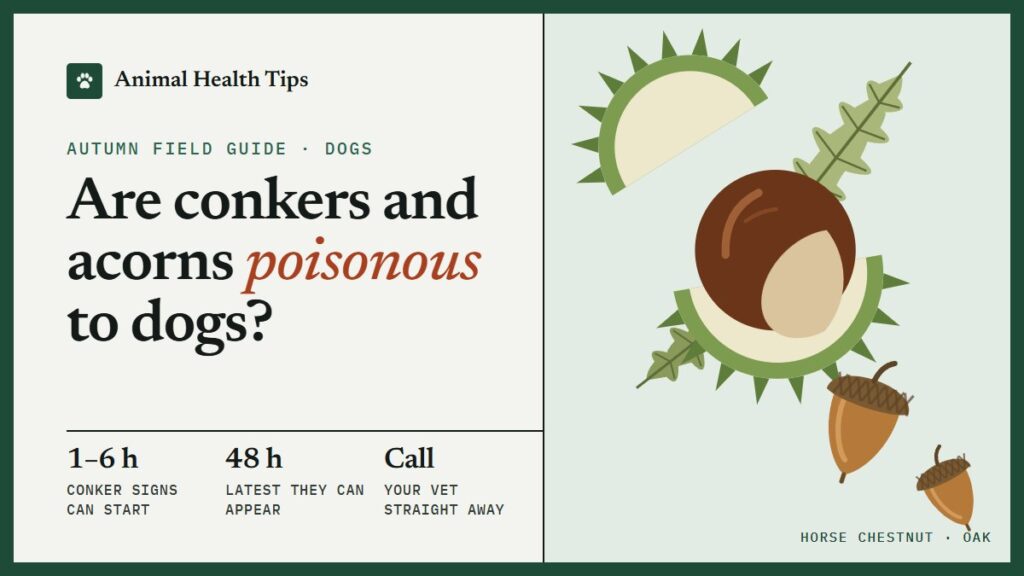
Every autumn, parks fill with shiny conkers and scattered acorns, and plenty of dogs treat them as toys or snacks. Both can make a dog unwell. Most dogs that swallow one recover with the right care, but a small number become seriously ill, so it pays to know the signs and what to do.
In this guide6 sections
Call your vet straight away if your dog has eaten conkers or acorns
- Do not wait for symptoms. Signs from conkers can take up to two days to appear.
- Go now if your dog collapses, is wobbly or trembling, keeps vomiting, or seems to be in pain.
- UK: Animal PoisonLine, 01202 509000 — open 24 hours, run by the Veterinary Poisons Information Service; a fee applies.
- US: ASPCA Animal Poison Control, (888) 426-4435 — open 24 hours; a consultation fee applies.
Why are conkers dangerous to dogs?
Conkers are the shiny brown seeds of the horse chestnut tree. They contain aesculin, and so do the other parts of the tree, including the bark and leaves. The ASPCA lists horse chestnut, which Americans also know as buckeye, as toxic to dogs, cats and horses.
The second risk is physical. A conker is hard and roughly the size of a large marble, so if a dog swallows one whole, it can get stuck and block the gut. That risk does not depend on the toxin at all.
Conkers are not the sweet chestnuts people roast. Those come from a different tree, and you can tell them apart by the husk: horse chestnut husks have short, thick spikes, while sweet chestnut husks are covered in fine, dense needles. Even so, do not let your dog eat either.
Why are acorns dangerous to dogs?
Acorns, the nuts of oak trees, contain tannins, which can upset a dog’s stomach. They are hard and sometimes have sharp points, so they can damage the gut or block it.
In rare cases, acorns lead to liver and kidney failure, which can be fatal. Blue Cross notes that the more acorns a dog eats, the sicker it is likely to become, so a dog that eats them by the mouthful under an oak tree is more at risk than one that picks up a single acorn.
What are the symptoms, and how soon do they start?
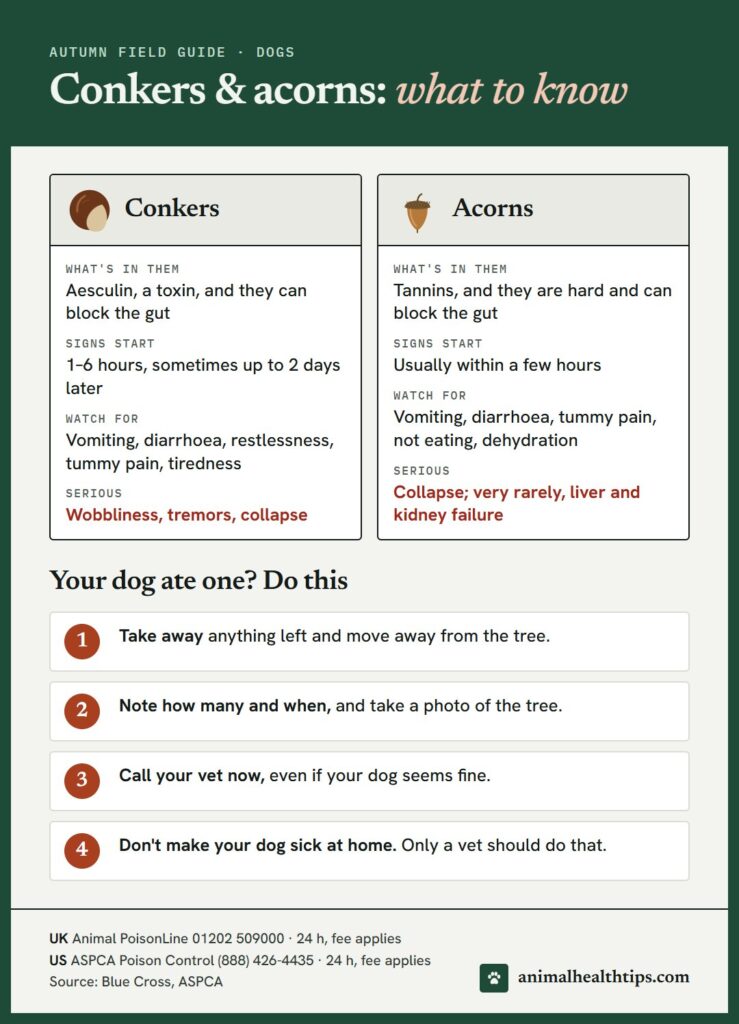
| Conkers | Acorns | |
|---|---|---|
| What is in them | Aesculin (plus the risk of a blockage) | Tannins (plus the risk of damage or a blockage) |
| When signs usually start | 1 to 6 hours, sometimes up to 2 days later | Within a few hours |
| Common signs | Vomiting, diarrhoea, restlessness, tummy pain, tiredness | Vomiting, diarrhoea, tummy pain, not eating, dehydration |
| Serious signs | Wobbliness, tremors, collapse | Collapse; very rarely, liver and kidney failure |
A blockage can look like ordinary sickness at first. Warning signs include repeated vomiting, especially when your dog cannot keep water down, a tense or sore belly, straining with little or no poo, and refusing food. A blockage needs a vet the same day.
What to do if your dog ate a conker or acorn
- Take away anything that is left and keep your dog away from the tree.
- Work out how many and when. Your vet will ask. Take a photo of the tree or keep a conker or acorn to show them.
- Phone your vet or an out-of-hours vet now, even if your dog seems fine. If you cannot reach a vet, call a pet poison line (numbers above).
- Do not try to make your dog sick at home. Salt and other home remedies can cause harm of their own. Only a vet should decide whether to do this.
- Watch your dog closely for the next two days and call back if any new sign appears.
Call your vet the same day if
- Your dog has vomited or had diarrhoea after a walk under horse chestnut or oak trees, even if you did not see it eat anything
- Your dog is off its food or quieter than usual in autumn
- You find chewed husks or acorn caps in your garden or your dog’s bed
How to keep your dog safe on autumn walks
- Learn the trees on your route. Horse chestnuts have large leaves shaped like a hand with five to seven fingers. Oak leaves have rounded or pointed lobes, and acorns sit in little cups. Keep your dog on a lead under them from September to November.
- Practise “leave it” and “drop” with high-value treats, so your dog gets a better reward than the conker.
- Never throw conkers for a game of fetch, and bring your dog’s own ball or toy instead.
- Clear your garden of fallen conkers and acorns every few days while the trees are dropping them.
- For dogs who eat everything, ask your vet or a trainer about a well-fitted basket muzzle for autumn walks. Your dog can still pant and drink in one.
Key takeaways
- Conkers (horse chestnut, also called buckeye) and acorns can both make dogs ill.
- Both can also block the gut, whatever the toxin does.
- Signs from conkers can take up to two days to appear, so call your vet straight away rather than waiting.
- Do not make your dog sick at home.
Frequently asked questions
How many conkers does it take to make a dog ill?
There is no known safe amount. Even a single conker can get stuck in the gut, especially in a smaller dog, so phone your vet whatever the number.
How long after eating a conker will a dog be sick?
Signs usually start within one to six hours, but they can appear up to two days later. That is why vets advise calling straight away instead of waiting to see what happens.
Are acorns more dangerous than conkers?
They carry different risks. Conkers contain aesculin and acorns contain tannins. With acorns, the amount matters: the more a dog eats, the sicker it is likely to be. Both can cause a blockage, so treat either as a reason to call your vet.
Are buckeyes the same as conkers?
They are close relatives. Conkers come from the European horse chestnut, and buckeyes come from American trees in the same family, such as the Ohio buckeye. The ASPCA lists them as toxic to dogs, cats and horses.
Is it safe for my dog to play with conkers?
No. A dog that chews or carries a conker can easily swallow it or swallow broken pieces, and the toxin is in the conker itself. Use a dog toy instead.
Should I make my dog sick after eating an acorn?
No. Do not try to make your dog vomit at home. Call your vet, who will decide whether it is safe and needed.
Sources
- Blue Cross — Are conkers poisonous to dogs?
- Blue Cross — Are acorns poisonous to dogs?
- ASPCA — Horse chestnut (buckeye): toxic and non-toxic plants
- Animal PoisonLine (VPIS) — 24-hour poison advice for pet owners
- ASPCA — Animal Poison Control Center
This guide is general information, not a diagnosis. If you are worried about your dog, contact your vet.