
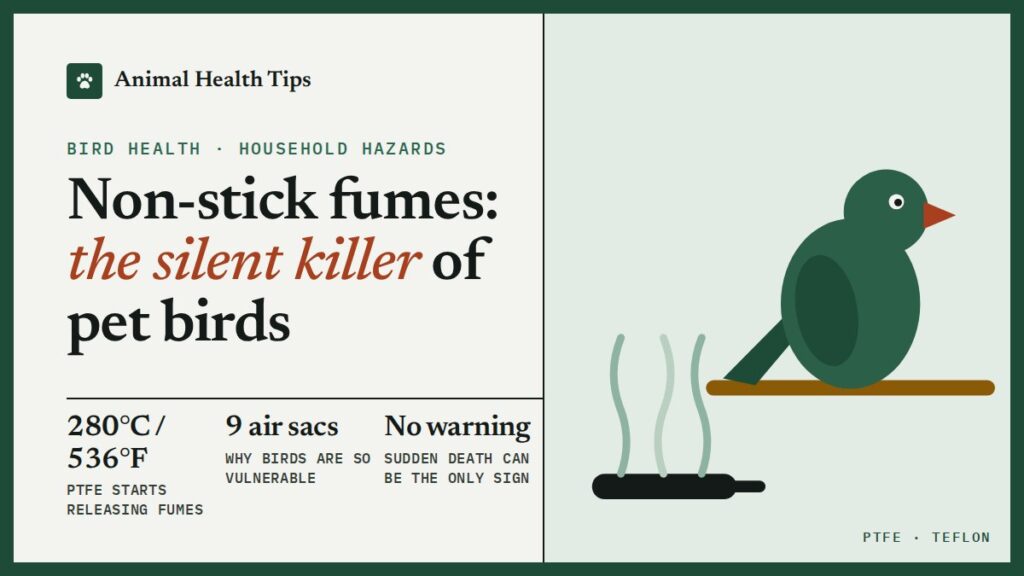
It sounds impossible: a pan on the hob in the kitchen, a parrot in the living room — and minutes later the bird is dead. Yet vets see it happen. The culprit is PTFE (polytetrafluoroethylene), the non-stick coating sold as Teflon. Overheated, it gives off fumes you cannot see or smell, and a bird’s lungs are so efficient at pulling gases from the air that the fumes can be fatal fast. With the cooking-heavy holiday season approaching, every bird owner should know this risk.
In this guide7 sections
Act now if your bird was near overheated non-stick cookware
- Move the bird to fresh air immediately.
- Call your vet for guidance straight away.
- Do not wait for symptoms — sudden death is often the first and only sign.
- UK: Animal PoisonLine, 01202 509000 — open 24 hours, run by the Veterinary Poisons Information Service; a fee applies.
- US: ASPCA Animal Poison Control, (888) 426-4435 — open 24 hours; a consultation fee applies.
What is PTFE and where is it in your home?
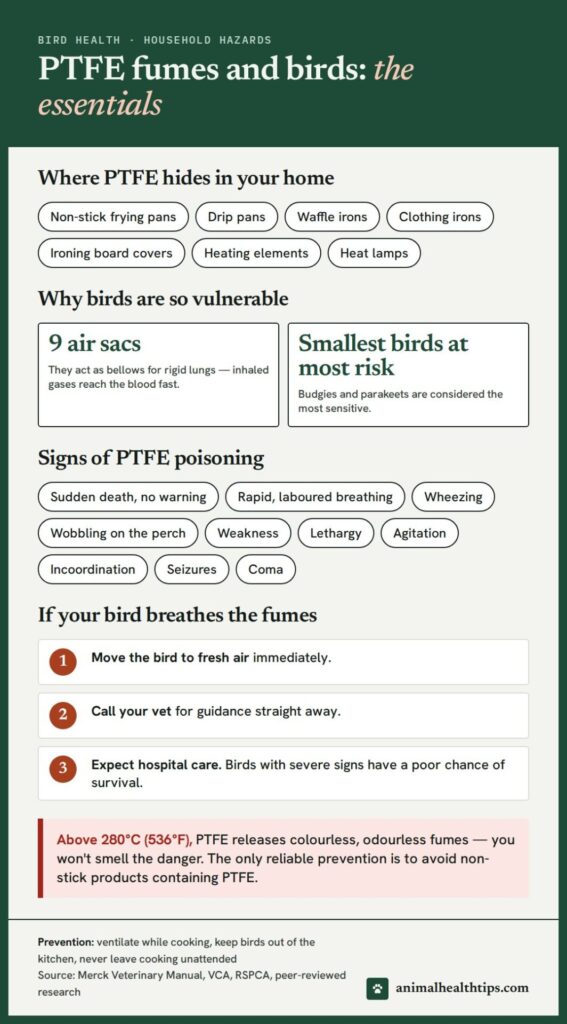
PTFE (polytetrafluoroethylene) is a synthetic coating valued for heat resistance and non-stick properties, sold under the brand name Teflon (Merck; peer-reviewed research). VCA lists where it hides around the home:
- Non-stick frying pans and drip pans
- Waffle irons
- Clothing irons and ironing board covers
- Heating elements and heat lamps
Most pet-bird cases come from overheated frying pans in the household, according to a peer-reviewed review. The classic scenario VCA describes is a non-stick pot boiling dry on the hob — but cases have also been reported from PTFE products used at recommended temperatures, so no setting is worth gambling on.
Why are birds so vulnerable to fumes?
Birds breathe differently from us. A peer-reviewed review explains: most birds have nine air sacs that work like bellows for rigid lungs, airflow runs in one direction, and gas exchange uses a highly efficient cross-current system. That efficiency is wonderful for flight — and terrible for toxins, because inhaled gases reach the blood at increased levels, quickly causing breathing failure and oxygen starvation.
The damage is direct and brutal. PTFE fumes cause caustic injury to the lungs — marked swelling and bleeding (Merck). On post-mortem examination, severe lung damage with fluid and bleeding is the typical finding.
Smaller birds are the most sensitive of all. VCA considers budgerigars (parakeets) the most sensitive to PTFE poisoning, and research notes cockatiels and budgerigars seem more sensitive than larger birds.
What are the signs of PTFE poisoning in birds?
The cruel part is how fast it happens. Merck notes that mild breathing difficulty and blood-tinged fluid around the beak and nostrils may appear — but in many cases birds are simply found dead with no warning signs at all. VCA says sudden death may be the only sign.
When signs do appear, they include:
- Rapid or laboured breathing, wheezing
- Agitation, then weakness and lethargy
- Wobbling while trying to stay upright on the perch, slow to respond
- Incoordination
- Seizures or coma
A review of cases lists open-beak breathing, chirping, incoordination, collapse, convulsions and death. Birds with severe signs have a poor chance of survival even with hospital care (VCA).
What to do if your bird breathes in the fumes
- Move the bird to fresh air immediately. Get them out of the contaminated area and into clean, well-ventilated air.
- Call your vet for guidance straight away. Do not wait to see whether symptoms develop.
- Expect hospital care. VCA says hospitalised care is generally needed for exposed birds — this is not something to manage at home.
- Ventilate the house before the bird returns, and stop using or remove the overheated item.
How to keep your bird safe in the kitchen
VCA is blunt: the only reliable way to prevent poisoning is to avoid non-stick products containing PTFE. If PTFE items are in your home, follow this:
| Do | Avoid |
|---|---|
| Ventilate: open windows and run the extractor fan while cooking | Heating a non-stick pan empty, or leaving cooking unattended |
| Keep birds out of the kitchen while cooking | Housing your bird in the kitchen — VCA says it holds too many hazards |
| Move an exposed bird to fresh air at once | Waiting for symptoms before acting |
| Check shared foods before offering them | Assuming everything from your plate is bird-safe |
The RSPCA adds two rules worth pinning to the fridge: always switch the extractor fan on or open a window before cooking — fumes spread through a house very quickly — and never leave your bird and hot pans unattended, even for a few minutes.
Bird-proofing the kitchen isn’t only about fumes — shared foods need a check too. See whether parrots can eat corn, and use our human food safety checker before sharing anything from your plate.
What other airborne dangers should bird owners know?
PTFE is the most notorious, but VCA lists a whole catalogue of airborne hazards for birds: cigarette, cigar and pipe smoke; essential oil diffusers and vaporisers; cooking fumes and oven smoke; carbon monoxide; fumes from cleaning products, paints and varnishes; fireplace fumes; air fresheners; hair products; dirty air ducts; and fumes slowly given off by new carpets and glues for months.
The RSPCA adds aerosol sprays, non-stick sprays, spray starch, perfumes, smoke, self-cleaning ovens and natural gas. VCA’s rule of thumb is memorable: if you can smell it, it may harm your bird’s respiratory tract — and harmful chemicals can linger long after the smell fades, so ventilation always matters.
And one absolute: never spray any aerosol near your bird.
Key takeaways
- Above 280°C (536°F), PTFE (Teflon) releases fumes that can kill a bird with no warning.
- Birds’ nine air sacs and super-efficient lungs make them uniquely vulnerable; budgies are most sensitive.
- Move an exposed bird to fresh air at once and call your vet — severe cases rarely survive.
- Avoid PTFE products, ventilate while cooking, and keep birds out of the kitchen.
Frequently asked questions
What temperature makes non-stick pans dangerous to birds?
Above 280°C (536°F), PTFE starts releasing toxic fumes, according to the Merck Veterinary Manual. But VCA reports cases from products used at recommended temperatures too — don’t treat any number as a safe line.
My bird is in another room. Is it safe?
No. VCA says birds can be poisoned even when they are not in the same room as the PTFE item, and the RSPCA notes fumes spread through a house very quickly.
Are some birds more at risk than others?
Yes. Smaller birds are the most sensitive, and VCA considers budgerigars (parakeets) the most sensitive of all.
Can humans be harmed by PTFE fumes?
Rarely. Overheated PTFE can cause “polymer fume fever” in people — flu-like fever, weakness, shivering and a sore throat (VCA).
Are self-cleaning ovens dangerous to birds?
The RSPCA lists self-cleaning ovens among the gases and fumes birds are highly sensitive to. Ventilate well and keep your bird well away while one runs.
Is there a bird-safe non-stick alternative?
No vet-approved source we found recommends specific alternatives. VCA’s advice stands: avoid PTFE products entirely, ventilate while cooking, and keep birds out of the kitchen.
Sources
- Merck Veterinary Manual — Poisonings in poultry (PTFE)
- VCA Animal Hospitals — Teflon (polytetrafluoroethylene) poisoning in birds
- VCA Animal Hospitals — Household hazards and dangers to birds
- RSPCA Australia — How will I keep my bird safe against household hazards?
- Peer-reviewed review (PMC) — Polytetrafluoroethylene toxicosis in birds
This guide is general information, not a diagnosis. If you are worried about your bird, contact your vet.