
Introduction
If you are afraid of spiders, you might want to look away. But if you are curious and fascinated by these eight-legged creatures, you might want to learn more about peacock spiders. These are not your ordinary spiders. They are the most colorful and adorable arachnids in the world. In this article, you will discover:
In this guide7 sections
- Introduction
- What are peacock spiders and where do they live?
- How do peacock spiders use their colors and patterns to attract mates and avoid predators?
- What are some of the most amazing facts and features of peacock spiders?
- How can you see peacock spiders in action and learn more about them?
- Frequently Asked Questions
- Note:
- What are peacock spiders and where do they live?
- How do peacock spiders use their colors and patterns to attract mates and avoid predators?
- What are some of the most amazing facts and features of peacock spiders?
- How can you see peacock spiders in action and learn more about them?
What are peacock spiders and where do they live?
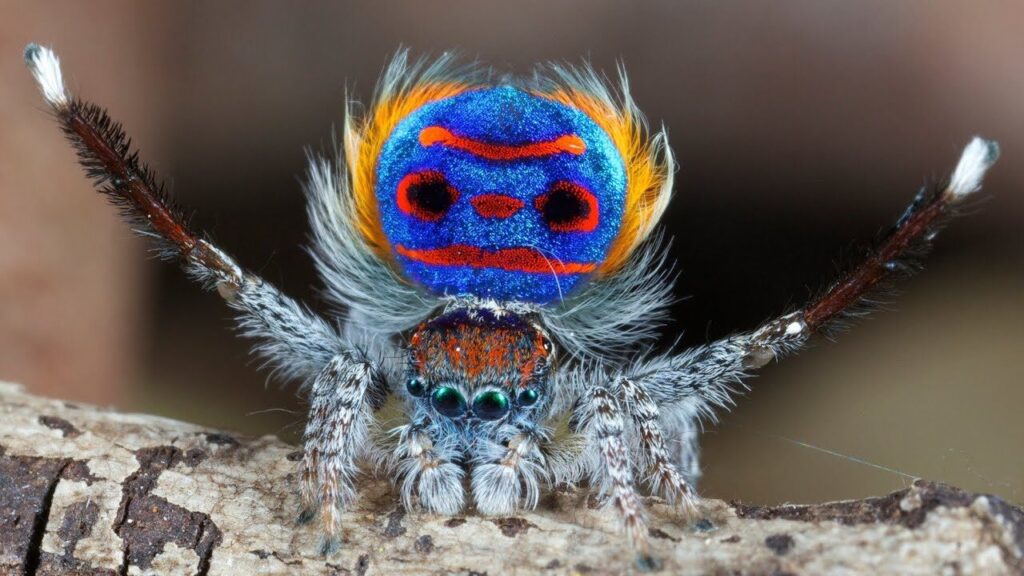
Peacock spiders are a group of jumping spiders that belong to the genus Maratus. They are named after peacocks because of their bright and iridescent colors and patterns on their abdomen, which they use for courtship displays. Peacock spiders are very small, ranging from 2.5 to 6 mm in length. They have eight eyes, four pairs of legs, and two fangs. They do not spin webs, but use their silk to make nests and draglines.
Peacock spiders are native to Australia and New Guinea, where they live in various habitats, such as forests, grasslands, deserts, and urban areas. They are mostly active during the day, hunting for insects and other small prey. They have excellent vision and can jump up to 20 times their body length.
How do peacock spiders use their colors and patterns to attract mates and avoid predators?
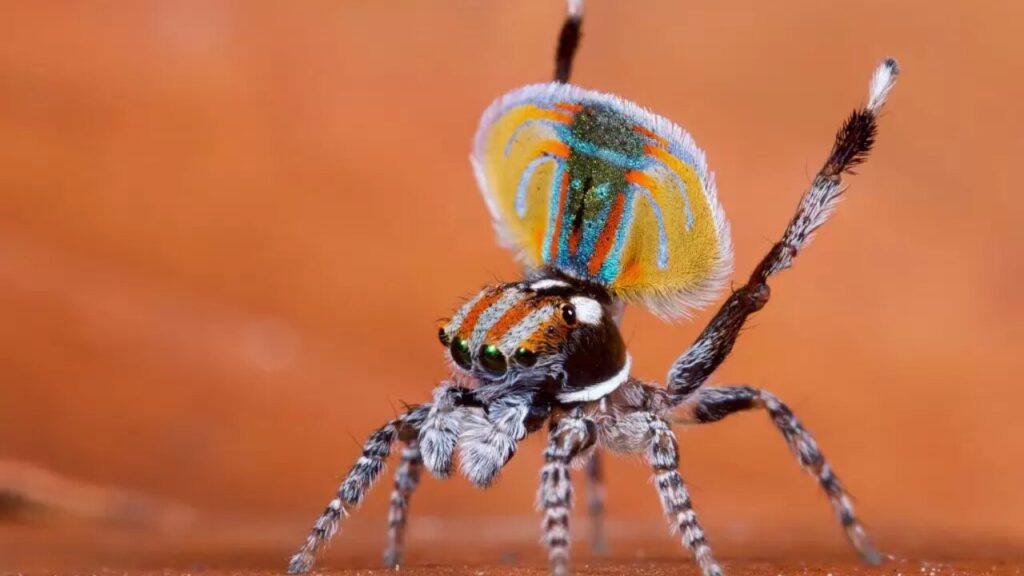
Peacock spiders are famous for their elaborate and colorful courtship displays, which involve raising and waving their abdomen, legs, and pedipalps (appendages near the mouth). They also vibrate their abdomen and make sounds by rubbing their legs together. These displays are mainly performed by males to impress and woo females, who are usually duller and less conspicuous. Each species of peacock spider has its own unique display and coloration, which helps them to recognize and attract their own kind.
However, peacock spiders also use their colors and patterns for another purpose: to avoid predators. Their bright colors can act as a warning signal to deter potential predators, such as birds, lizards, and ants. Their patterns can also help them to camouflage and blend in with their surroundings, such as flowers, leaves, and rocks. Some peacock spiders can even mimic the appearance of other animals, such as ants, beetles, and wasps, to fool their enemies.
What are some of the most amazing facts and features of peacock spiders?
Peacock spiders are not only beautiful and charming, but also have some amazing facts and features that make them stand out from other spiders. Here are some of them:
- Peacock spiders have more than 80 known species, and new ones are being discovered every year. Some of the most recently described species include Maratus constellatus, which has a starry pattern on its abdomen, Maratus volans, which has a flap-like extension on its abdomen that resembles a pair of wings, and Maratus karrie, which has a heart-shaped mark on its abdomen.
- Peacock spiders are not harmful to humans. They do not have venom glands, and their fangs are too small and weak to pierce human skin. They are also very shy and timid, and will usually run away or play dead when threatened. They are more likely to bite each other than humans, especially during mating, when females sometimes eat males after copulation.
- Peacock spiders are very intelligent and can learn from their experiences. They can remember the locations of their nests, prey, and mates, and can adjust their behavior according to the situation. They can also communicate with each other using visual, auditory, and tactile signals, and can recognize and respond to different individuals.
How can you see peacock spiders in action and learn more about them?
If you are interested in seeing peacock spiders in action and learning more about them, you have several options. You can:
- Watch videos and documentaries of peacock spiders on YouTube and other platforms. Some of the most popular and informative ones are made by Jürgen Otto, a biologist and photographer who has been documenting and studying peacock spiders for over a decade. You can find his channel here: https://www.youtube.com/user/Peacockspiderman
- Read books and articles about peacock spiders on the internet and in libraries. Some of the most recommended ones are Peacock Spiders by Jürgen Otto and David Hill, a comprehensive guide to the diversity and behavior of peacock spiders, and The Peacock Spider Dance by Nicky Jenner, a children’s book that introduces peacock spiders to young readers.
- Visit museums and zoos that have peacock spiders on display or in captivity. Some of the places where you can see peacock spiders are the Australian Museum in Sydney, the Queensland Museum in Brisbane, and the Taronga Zoo in Sydney.
- Go on a field trip or a tour to see peacock spiders in their natural habitat. You can join organized groups or hire guides that specialize in finding and observing peacock spiders in Australia and New Guinea. You can also try to find them yourself, but be careful and respectful of their environment and safety.
Frequently Asked Questions
Here are some of the most common questions and answers about peacock spiders:
Peacock spiders have a short lifespan, ranging from a few months to a year. They usually die after mating or laying eggs, or due to predation, parasitism, or environmental factors.
Peacock spiders lay between 10 and 30 eggs, depending on the species and the availability of food and shelter. They usually lay their eggs in a silk cocoon, which they guard and protect until they hatch.
Peacock spiders get their colors from two sources: pigments and structures. Pigments are chemicals that produce colors, such as melanin, carotenoids, and flavonoids. Structures are microscopic features that reflect and refract light, such as scales, hairs, and crystals. Peacock spiders combine pigments and structures to create their dazzling and diverse colors and patterns.
Peacock spiders are not endangered, but they are vulnerable to habitat loss, fragmentation, and degradation, due to human activities such as agriculture, urbanization, and mining. They are also threatened by invasive species, such as fire ants, cane toads, and cats, that prey on them or compete with them for resources. Peacock spiders need our help and conservation to survive and thrive in the future.
Peacock spiders are not suitable pets for several reasons. They are very small and delicate, and require special care and conditions to survive in captivity. They are also very rare and valuable, and collecting them from the wild may harm their populations and ecosystems. They are best appreciated and admired from a distance, or through photos and videos.
Note:
So in This Post, Peacock Spiders what points can you think of/have experienced? Let me know in the comments.
If you found this helpful feel free to share your experience if you can relate to these points and if you are comfortable to share
For More Articles Related to Animal Health Stay Tuned To our Site